








Children are born curious. They ask questions, explore their surroundings, and try to understand how the world works long before they ever enter a classroom. This natural curiosity is one of the most powerful drivers of learning—yet it is often the first thing that formal education unintentionally suppresses.
Montessori education begins with a simple belief: when curiosity is protected and encouraged, learning follows naturally.
Learning Begins With Wonder
In the early years, children learn not because they are told to, but because they want to. They touch, observe, question, and experiment. Montessori classrooms are designed to preserve this sense of wonder rather than replace it with rigid instruction.
Instead of rushing children through a fixed syllabus, Montessori-inspired learning allows them time to explore ideas deeply. When children are genuinely interested, they concentrate longer, retain information better, and develop a deeper understanding of concepts.
Curiosity turns learning from a task into a joy.
From Passive Listening to Active Engagement
Traditional classrooms often place children in a passive role—listening, copying, and repeating. While this may cover content, it does not always nurture thinking.
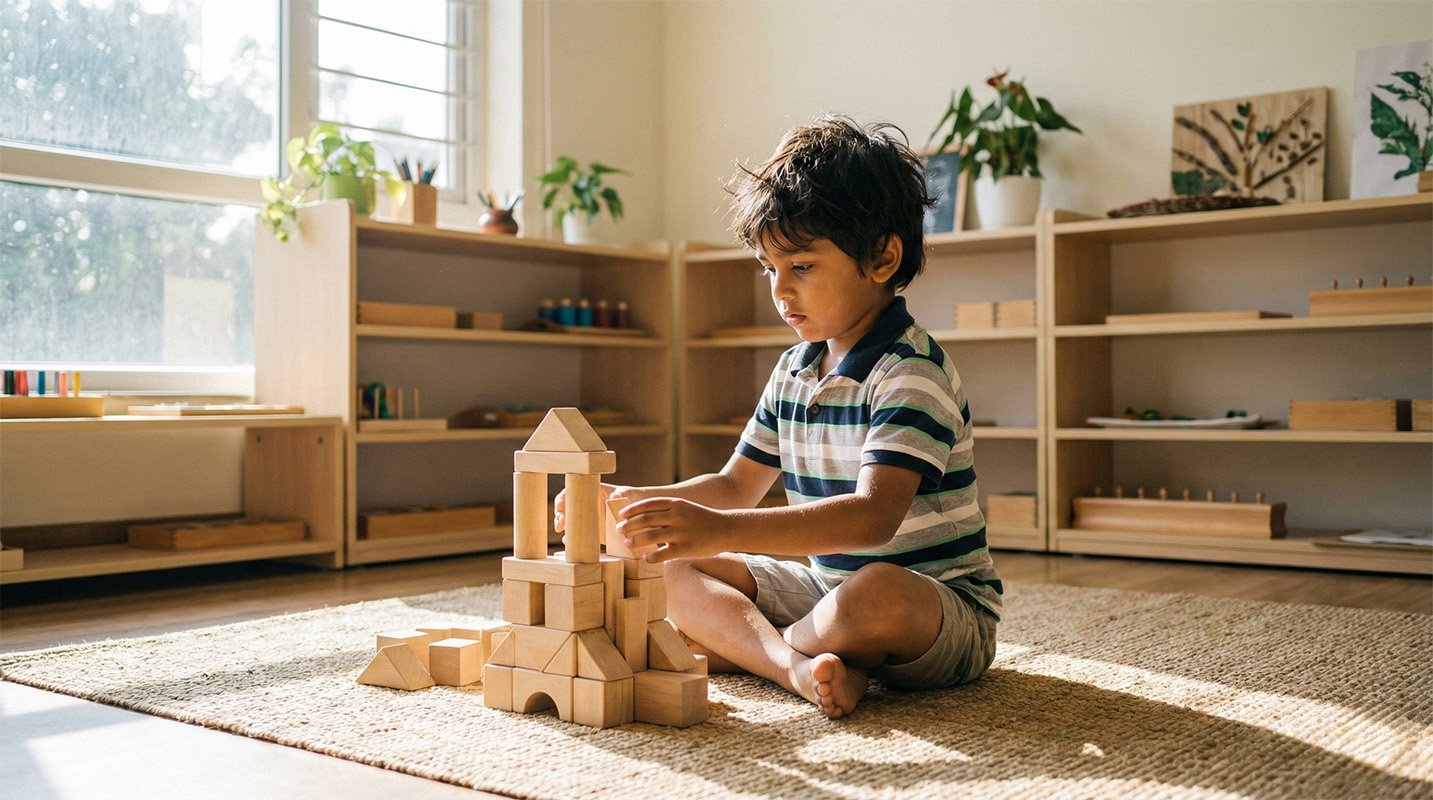
In a Montessori environment, children learn by doing. They engage with materials, work through problems with their hands and minds, and make connections on their own. This active engagement helps children build confidence in their ability to learn independently and encourages them to ask meaningful questions.
When curiosity leads the way, children do not simply wait for answers—they seek them.
Encouraging Questions, Not Just Correct Answers
In many learning environments, children quickly learn that being right matters more than being curious. Over time, this fear of making mistakes can silence questions and limit exploration.
Montessori education creates space for questions. Mistakes are seen as part of the learning process, not something to be avoided. Children are encouraged to reflect, try again, and discover solutions at their own pace.
This approach builds resilience and nurtures a mindset where learning is about growth rather than perfection.
Curiosity and Academic Excellence Can Coexist
There is a common misconception that curiosity-driven learning lacks academic rigour. In reality, curiosity strengthens academics. When children understand why they are learning something, they engage more deeply and perform better over time.
Curious learners are more likely to connect ideas across subjects, apply concepts in new situations, and retain what they learn. These skills become especially valuable as children progress to higher grades, where independent thinking and problem-solving are essential.
Nurturing Curious Minds at Tharakans High
At Tharakans High, curiosity is not treated as a distraction from learning—it is recognised as the starting point. Montessori principles guide classroom practices that encourage exploration, discussion, and reflection, while maintaining academic clarity and structure.
Teachers create environments where questions are welcomed, ideas are explored, and learning is meaningful. Students are guided to think deeply, not just complete tasks.
Learning That Lasts a Lifetime
Facts may be forgotten, but curiosity stays. Children who learn to ask questions, seek understanding, and enjoy learning carry these habits with them throughout life.
By treating curiosity as the real curriculum, Montessori education helps children grow into thoughtful, adaptable learners—ready not just for exams, but for a world that values curiosity, creativity, and lifelong learning.